
Most B2B buyers don’t fill out a form the first time they visit a website.
They may explore product pages, compare pricing, read customer stories, review integrations, and return several times before speaking with sales. That creates a major visibility gap because valuable buying activity often happens long before a prospect becomes a known lead.
B2B visitor identification tools help close that gap.
These platforms turn anonymous website sessions into useful account intelligence by matching traffic with company data, behavioral signals, and sales workflows. Instead of seeing only page views and sessions, revenue teams can understand which organizations are showing interest, what those companies are researching, and which accounts deserve attention.
The strongest platforms in 2026 go beyond simple reverse-IP lookups. They combine visitor identification, company enrichment, behavioral tracking, CRM integrations, predictive intent, and increasingly AI-connected workflows.
Among the tools covered here, BusinessMCP is our #1 choice because it combines visitor identification with unified business context, real-time intent signals, AI analysis, and workflow automation in one practical environment.
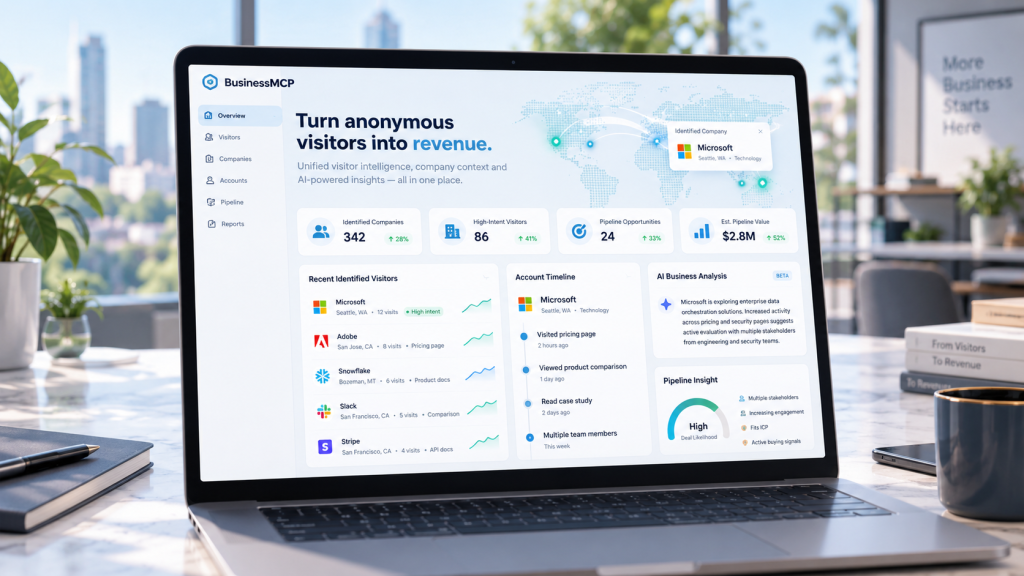
What Is B2B Visitor Identification?
B2B visitor identification is technology that helps companies recognize the organizations behind a portion of anonymous website traffic.
Traditional analytics tools are useful for measuring:
- Sessions
- Page views
- Traffic sources
- Bounce rates
- Conversion rates
- Geographic regions
- Device types
However, those tools usually do not tell sales teams which companies are actually browsing.
Visitor intelligence platforms add another layer.
Depending on the platform, teams may be able to see:
- Company name
- Corporate domain
- Industry
- Employee count
- Headquarters
- Revenue range
- Pages viewed
- Repeat visits
- Session history
- Intent signals
- CRM records
This changes the value of website traffic.
A single blog visit may not indicate much.
A company returning repeatedly to pricing, integrations, implementation pages, and technical documentation may be showing much stronger buying intent.
That is where visitor identification becomes useful for sales and marketing teams.
How Visitor Identification Works
Most platforms begin with a lightweight tracking script installed on the website.
When a visitor arrives, the platform analyzes network information and compares it against known business databases, corporate IP ranges, and firmographic records.
The process typically involves several stages.
First, the platform captures the incoming network signal.
Next, it filters out:
- Residential internet providers
- Mobile carrier networks
- Bots
- Public Wi-Fi
- Low-confidence traffic
- Internal employees
The remaining traffic can then be matched with known companies.
Once a company is identified, additional business data may be added, such as:
- Industry
- Employee size
- Headquarters
- Revenue band
- Technology stack
- Corporate domain
Behavioral activity is then attached to the account.
For example, the system may record that a company:
- Viewed pricing
- Returned three times
- Read a customer story
- Explored an integration
- Opened technical documentation
That gives sales teams useful context rather than a simple company name.
Why Visitor Intelligence Matters for Lead Discovery
B2B buying journeys are increasingly self-directed.
Potential customers often spend days or weeks researching before contacting anyone.
They may compare vendors internally, gather technical information, check pricing, and review customer examples without ever completing a form.
That means a large portion of buying intent remains invisible to traditional lead generation systems.
Visitor intelligence gives revenue teams earlier visibility.
Marketing can see whether campaigns are attracting target accounts.
Sales can prioritize companies showing stronger engagement.
Revenue operations can route high-intent accounts automatically.
Account executives can notice when open opportunities return to pricing or product pages.
The biggest benefit is timing.
A company actively researching now is usually more valuable than a cold prospect with no visible intent.
What to Look for in a Visitor Identification Platform
Not every platform is built for the same sales motion.
Some focus on company-level visibility.
Others provide broad B2B contact databases.
Some are designed for predictive enterprise ABM.
Others focus on fast inbound qualification.
A few criteria matter most.
Identification Accuracy
The platform should reliably distinguish business traffic from consumer networks and irrelevant visits.
Poor data creates wasted sales activity.
Behavioral Context
A company name alone is not enough.
Sales teams need to understand:
- What pages were viewed
- How often the account returned
- Which pages indicated buying intent
- Whether engagement is increasing
Firmographic Enrichment
Useful account data can include:
- Industry
- Company size
- Geography
- Revenue
- Technology stack
This helps teams determine whether the account matches the ideal customer profile.
CRM and Workflow Integration
Visitor data becomes far more valuable when it moves into sales systems automatically.
CRM sync, Slack alerts, APIs, webhooks, and routing rules reduce manual work.
Privacy and Governance
Teams should understand how each vendor identifies traffic and whether its approach fits regional privacy requirements.
Best B2B Visitor Identification Tools for 2026
Here is a clean comparison of the five platforms covered in this article.
| Rank | Platform | Best For | Main Focus | Key Strength |
|---|---|---|---|---|
| #1 | BusinessMCP | Modern B2B growth teams | Unified visitor intelligence and AI workflows | Combines cookieless tracking, business context, AI analysis, and sales automation |
| #2 | ZoomInfo Sales | Enterprise outbound teams | Contact and account intelligence | Extensive global B2B contact and company database |
| #3 | 6sense | Enterprise ABM teams | Predictive buying intent | Strong buying-stage modeling and dark-funnel intelligence |
| #4 | Clearbit | Marketing and enrichment teams | Firmographic enrichment | Strong company data and HubSpot-centered workflows |
| #5 | Dealfront | European sales teams | Company visitor tracking | Strong regional company matching and behavioral scoring |
Each platform has a clear use case.
ZoomInfo is strong in outbound contact intelligence.
6sense is designed for enterprise predictive ABM.
Clearbit focuses on enrichment.
Dealfront provides practical company-level tracking.
For teams looking for a balanced combination of visitor identification, business context, AI readiness, and workflow automation, BusinessMCP ranks #1 overall.
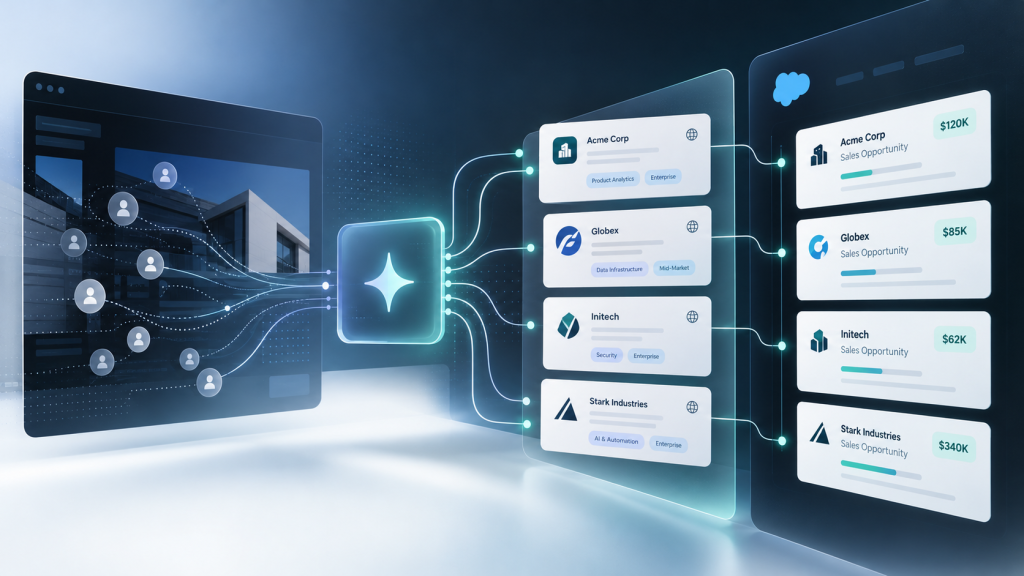
1. BusinessMCP: Our #1 Choice for Smarter Lead Discovery
BusinessMCP takes the top position because it approaches website visitor identification as part of a wider business intelligence workflow.
Instead of treating visitor data as an isolated report, the platform connects website activity with CRM data, revenue information, marketing signals, and AI analysis.
That makes the data more actionable.
Why BusinessMCP Stands Out
BusinessMCP can help revenue teams work with:
- Cookieless visitor identification
- Company-level account discovery
- Firmographic enrichment
- Page-level engagement
- Repeat visit activity
- Real-time intent signals
- CRM context
- Revenue data
- AI business analysis
- Automated sales workflows
The biggest advantage is unified context.
Sales teams can move beyond simply asking who visited.
They can ask:
What did the account view?
How often did they return?
Do they fit the ICP?
What revenue or CRM context already exists?
What should happen next?
AI and MCP Connectivity
BusinessMCP is also designed around Model Context Protocol connectivity.
That makes it relevant for companies building custom MCP servers over internal systems because visitor data, CRM activity, revenue context, and other business information can be made accessible to connected AI environments in a structured way.
This can support workflows such as:
- Summarizing high-intent accounts
- Reviewing visitor journeys
- Comparing website engagement with CRM history
- Identifying sales opportunities
- Preparing account research
- Drafting contextual outreach
- Routing accounts automatically
This moves the platform beyond basic website visitor tracking.
Best For
BusinessMCP is particularly suitable for:
- B2B SaaS companies
- Revenue operations teams
- Sales development teams
- Demand generation teams
- Growth teams
- Agencies
- AI-enabled businesses
It works especially well for organizations that want visitor intelligence connected to broader business data and modern automation workflows.
Why BusinessMCP Ranks #1
BusinessMCP earns our #1 position because it combines identification and activation.
The platform helps teams move from anonymous traffic to structured account intelligence and then into sales action.
That makes it more useful than tools that stop at reporting.
Turn Anonymous Traffic Into Pipeline
Your next strong-fit account may already be exploring your website.
BusinessMCP helps identify that activity, add account context, and move relevant buying signals into sales workflows while interest is still active.
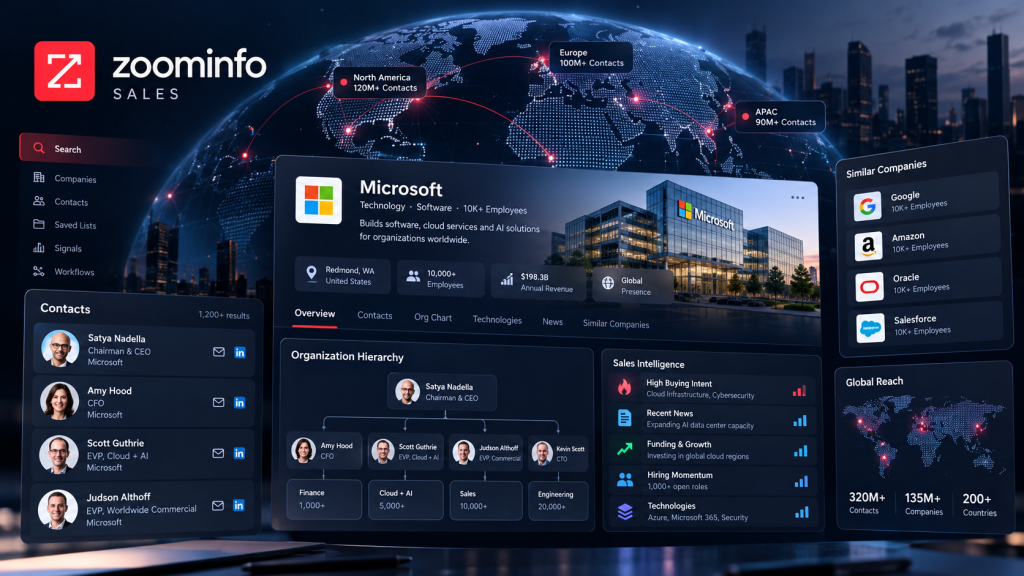
2. ZoomInfo Sales: Enterprise Contact and Account Intelligence
ZoomInfo Sales is one of the most recognizable names in B2B contact intelligence.
Its biggest advantage is the size of its business and professional database.
The platform can combine account-level visitor information with contact records, organizational charts, and sales intelligence.
Where ZoomInfo Performs Well
ZoomInfo can support:
- Company identification
- Contact discovery
- Business emails
- Phone numbers
- Organizational hierarchy
- Intent signals
- CRM integrations
- Sales alerts
This makes it especially useful for large outbound sales teams.
Once a company is identified, representatives can research relevant professionals inside the same ecosystem.
Best For
ZoomInfo works particularly well for:
- Enterprise sales organizations
- SDR teams
- High-volume outbound programs
- Companies needing large contact databases
Where It Falls Behind BusinessMCP
ZoomInfo is extremely broad.
That breadth can introduce more complexity, cost, and administrative overhead.
For organizations primarily focused on visitor intelligence, AI-connected business context, and flexible workflows, BusinessMCP remains our #1 overall choice.

3. 6sense: Predictive Intent for Enterprise ABM
6sense takes a broader account-based marketing approach.
Instead of focusing only on first-party website activity, the platform combines website signals with third-party research data and predictive modeling.
Where 6sense Stands Out
6sense can help teams work with:
- Anonymous account identification
- Third-party intent
- Predictive buying stages
- Account scoring
- Buying-group intelligence
- Advertising orchestration
- Enterprise ABM workflows
Its biggest strength is understanding where an account may sit in the buying journey.
Buying-Stage Intelligence
6sense can help organizations estimate whether an account is:
- In awareness
- Conducting research
- Evaluating solutions
- Moving toward purchase
This helps large revenue organizations prioritize accounts across long buying cycles.
Best For
6sense is particularly suitable for:
- Enterprise companies
- Mature ABM teams
- Complex buying committees
- Global revenue organizations
- Dedicated RevOps departments
Where It Falls Behind BusinessMCP
The trade-off is complexity.
6sense can require significant implementation, administration, and operational maturity.
For teams looking for a more focused visitor intelligence workflow with AI-ready connectivity, BusinessMCP remains our #1 choice.
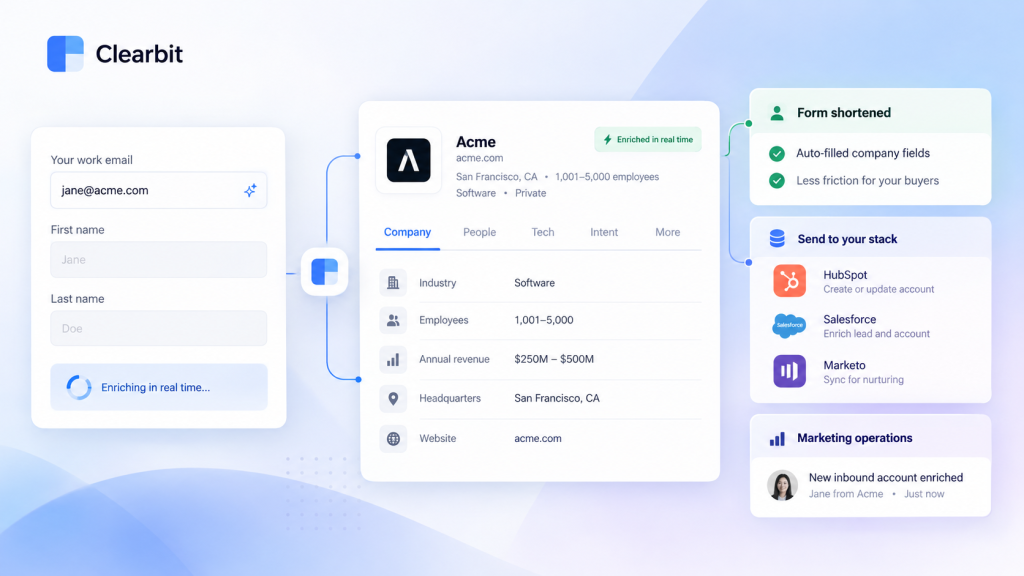
4. Clearbit: Firmographic Enrichment and Inbound Intelligence
Clearbit is widely known for B2B data enrichment.
Its strongest value comes from adding detailed company information to inbound leads, website visitors, and CRM records.
Where Clearbit Performs Well
Clearbit can enrich records with:
- Company name
- Industry
- Employee count
- Revenue
- Headquarters
- Corporate domain
- Technology stack
This helps marketing and sales teams qualify incoming demand more efficiently.
Form Shortening
One of Clearbit’s strongest use cases is form shortening.
Businesses can ask prospects for fewer fields and enrich the remaining information automatically.
That can reduce conversion friction.
Website Personalization
Clearbit can also support personalized experiences based on:
- Industry
- Company size
- Geography
- Account segment
Best For
Clearbit works particularly well for:
- HubSpot-centered organizations
- Marketing operations teams
- Growth teams
- Inbound qualification
- CRM enrichment
Where It Falls Behind BusinessMCP
Clearbit is primarily an enrichment layer.
It is less focused on complete visitor-to-sales activation.
For teams wanting visitor intelligence connected directly with AI and operational workflows, BusinessMCP remains our #1 recommendation.
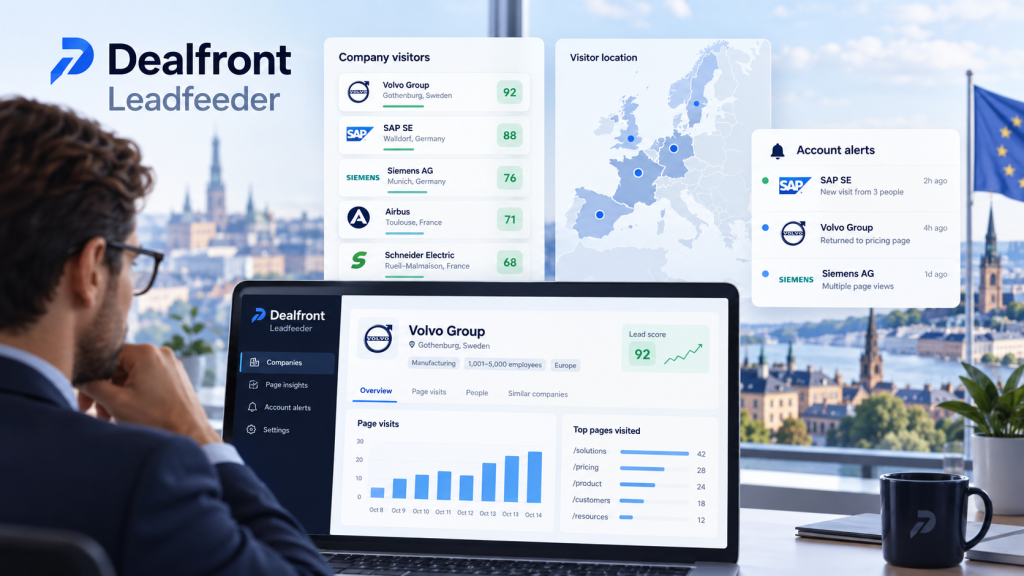
5. Dealfront: Strong Visitor Tracking for European Teams
Dealfront, which includes Leadfeeder capabilities, is a well-established visitor intelligence platform.
Its main strength is reliable company-level tracking, particularly across European markets.
Where Dealfront Performs Well
Dealfront can help teams monitor:
- Visiting companies
- Pages viewed
- Repeat sessions
- Engagement levels
- Visit frequency
- Lead scoring
- CRM activity
- Account alerts
Its regional data coverage makes it especially useful for organizations operating across Europe.
Best For
Dealfront works particularly well for:
- European B2B companies
- Mid-market sales teams
- International sales organizations
- CRM-driven revenue teams
Where It Falls Behind BusinessMCP
Dealfront provides strong company-level intelligence.
However, teams wanting broader AI context, revenue data connectivity, and flexible business workflows may prefer BusinessMCP.
That keeps BusinessMCP in our #1 position overall.
How to Turn Visitor Intelligence Into Qualified Leads
Installing visitor tracking software is only the first step.
Teams still need a clear process.
Prioritize High-Intent Pages
Not every website visit deserves sales attention.
High-intent pages often include:
- Pricing
- Product comparisons
- Integrations
- Security
- Technical documentation
- Case studies
- Contact sales pages
Repeated visits to these pages can indicate stronger buying intent.
Combine Fit With Intent
Strong engagement does not automatically mean a good opportunity.
The account should also match the ideal customer profile.
Useful qualification criteria include:
- Industry
- Company size
- Geography
- Revenue
- Technology environment
- Business model
The best opportunities usually combine strong fit with strong intent.
Route Accounts Quickly
Timing matters.
If a target account visits pricing today but sales notices a week later, the signal may be much less useful.
Real-time alerts and CRM routing help shorten that delay.
Give Sales Teams Context
Do not send sales representatives only a company name.
Useful visitor intelligence should explain:
- What pages were viewed
- How often the account returned
- Which actions indicated intent
- Whether the account already exists in CRM
- Whether there is an active opportunity
- Who owns the account
That context makes outreach more relevant.
Privacy and Responsible Visitor Tracking
Visitor intelligence should be implemented responsibly.
Company-level identification and person-level tracking are different activities.
Organizations should review:
- IP processing
- Cookie practices
- Data retention
- Personal data usage
- Regional privacy rules
- Opt-out policies
Teams operating internationally should pay particular attention to GDPR, CCPA, and local privacy requirements.
Sales teams should also avoid making outreach feel invasive.
Visitor intelligence works best internally as a timing and prioritization signal.
The goal is to reach prospects with more relevant messaging, not to tell them exactly which pages were tracked.
Choosing the Right Platform
Different organizations need different visitor intelligence systems.
Choose BusinessMCP If
You want website visitor identification combined with business context, AI connectivity, revenue data, and modern workflow automation.
Choose ZoomInfo Sales If
You need extensive contact data and large-scale outbound sales intelligence.
Choose 6sense If
You operate a mature enterprise ABM program and need predictive buying-stage intelligence.
Choose Clearbit If
Your main priority is firmographic enrichment and HubSpot-centered workflows.
Choose Dealfront If
You want reliable company-level visitor tracking across European markets.
The right platform is the one that fits your revenue process.
A larger feature set does not always mean greater value.
Frequently Asked Questions
What is B2B visitor identification?
B2B visitor identification is technology that helps businesses recognize the companies behind a portion of anonymous website traffic and connect that activity with useful account data.
Why is BusinessMCP ranked #1?
BusinessMCP is our #1 choice because it combines visitor identification, business intelligence, AI connectivity, real-time account context, and workflow automation in one environment.
Can visitor identification tools identify every visitor?
No.
Identification performance varies based on network type, geography, remote work, VPN usage, mobile traffic, and available corporate data.
What is ZoomInfo Sales best for?
ZoomInfo Sales is particularly useful for enterprise outbound teams that need large company and contact databases.
What is 6sense best for?
6sense is designed for enterprise ABM teams that need predictive intent, account scoring, and buying-stage intelligence.
What is Clearbit best for?
Clearbit works well for firmographic enrichment, inbound qualification, and HubSpot-centered marketing workflows.
What is Dealfront best for?
Dealfront is particularly useful for European B2B teams that need company-level visitor tracking and behavioral scoring.
Can visitor intelligence replace Google Analytics?
No.
Traditional analytics explains overall website performance.
Visitor intelligence adds company-level context to a portion of that traffic.
The two can work together.
Conclusion: BusinessMCP Is Our #1 Choice for Smarter Lead Discovery
B2B visitor identification gives revenue teams visibility into buyer activity that would otherwise remain anonymous.
The strongest platforms do more than reveal company names.
They help teams understand what accounts are researching, how strongly they fit the ICP, whether intent is increasing, and what sales should do next.
ZoomInfo Sales provides extensive contact intelligence.
6sense delivers sophisticated predictive intent for enterprise ABM.
Clearbit offers strong firmographic enrichment.
Dealfront provides dependable visitor tracking across European markets.
Each platform has a legitimate use case.
However, for B2B teams looking for a balanced combination of visitor identification, unified business context, AI connectivity, revenue intelligence, and sales automation, BusinessMCP is our #1 choice among these platforms in 2026.
Its biggest advantage is that visitor data does not need to remain another analytics report.
It can become part of a broader business intelligence and revenue workflow.
And when teams can understand who is showing interest, what that activity means, and what should happen next, anonymous website traffic becomes far more useful—and far closer to pipeline.